
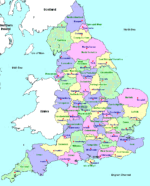
English devolution has developed in a way that prioritises administrative convenience over democratic legitimacy. Rather than transferring power directly to accountable local institutions, successive governments have often channelled authority through quasi-independent bodies, quangos, combined authorities, and appointed boards.
This model raises fundamental concerns about accountability. Organisations operating at arm’s length from government may or may not deliver services efficiently, but they are not directly answerable to voters. The National Audit Office has repeatedly highlighted the difficulty in scrutinising such bodies, particularly where responsibilities overlap or reporting becomes unclear.
Counties offer a more grounded alternative. They are longstanding administrative units with recognisable boundaries and elected councils. Unlike many combined authorities, they carry public legitimacy and historical continuity. In areas like Suffolk or Yorkshire, identity and governance are closely linked.
The current system creates ‘layers of power’ dispersed across ‘layers of bureaucracy’ without genuine local control. The Institute for Government has described English devolution deals as “centrally designed and negotiated,” limiting their responsiveness to local needs.
Giving counties more power would need to involve fiscal responsibility, planning authority, and integrated service delivery at a county level. Crucially, it would ensure that those making decisions can be held accountable through elections.
There is a broader democratic principle at stake. Governance should be visible, understandable, and responsive. When power is exercised by unelected or indirectly accountable bodies, public trust erodes. Giving more power to counties would not eliminate all the problems that increasingly exist but it would restore a clearer link between decision-making and democratic consent.
Steve Davis
Campaign Chairman
Campaign for an English Parliament